
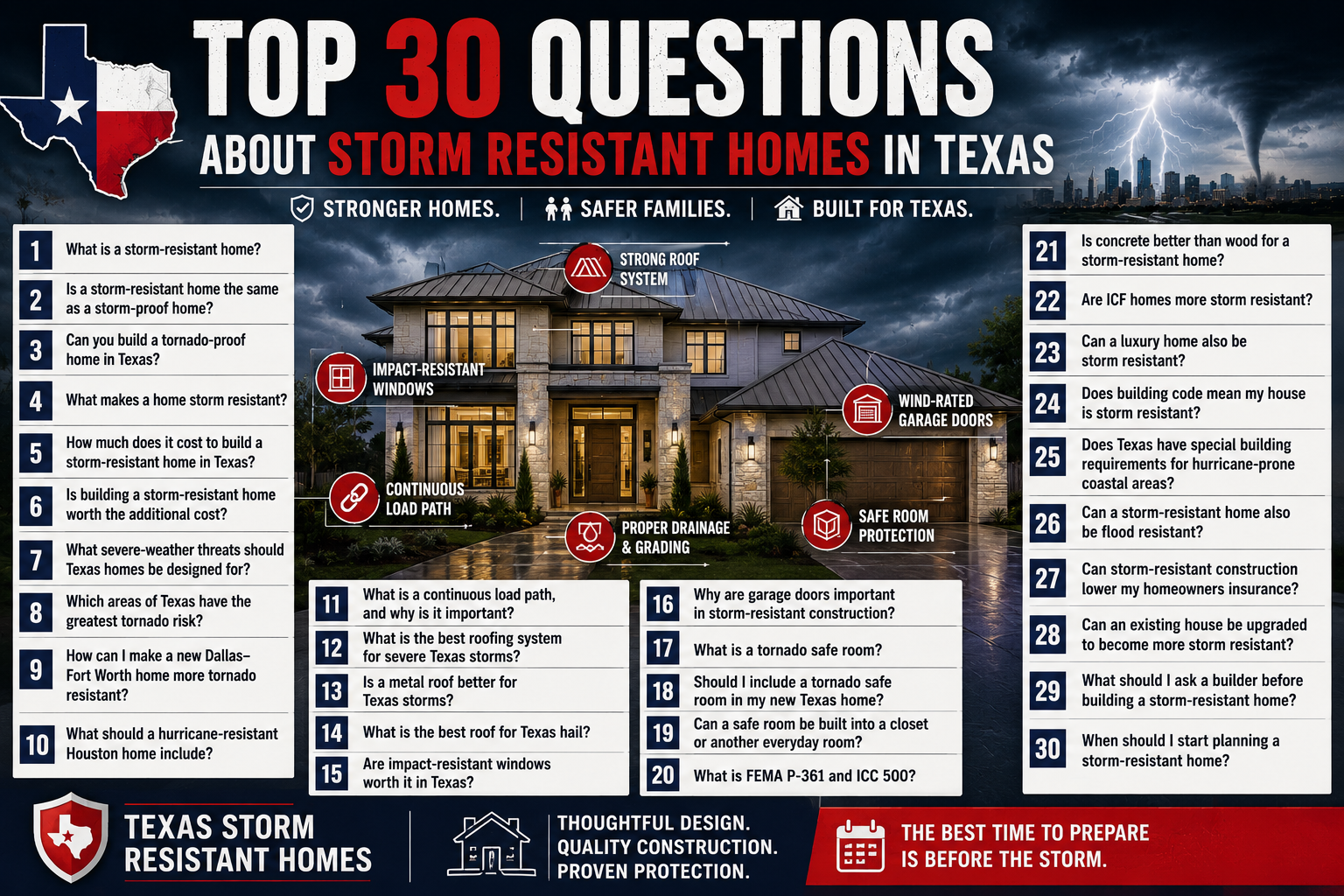
Top 30 FAQs About Storm-Resistant Homes in Texas
1. What is a storm-resistant home?
A storm-resistant home is intentionally designed and constructed to better withstand severe-weather hazards such as tornadoes, hurricanes, extreme winds, hail, flying debris, heavy rainfall, and flooding.
2. Is a storm-resistant home the same as a storm-proof home?
No home can be guaranteed to withstand every possible natural disaster. “Storm-resistant” or “resilient” is more technically accurate, although “storm-proof home” is a commonly used term.
3. Can you build a tornado-proof home in Texas?
A home can be engineered to provide significantly greater resistance to tornado-related winds and debris, but no conventional house should be guaranteed tornado-proof. A properly designed storm safe room provides an additional level of life-safety protection.
4. What makes a home storm resistant?
Storm resistance comes from the entire building working together—foundation, walls, roof, structural connections, windows, doors, garage openings, drainage, and other critical systems.
5. How much does it cost to build a storm-resistant home in Texas?
The additional cost depends on the home’s size, location, architecture, structural system, roofing, windows, safe room, engineering, and desired level of resilience. Many features are considerably easier to incorporate during new construction than retrofit later.
6. Is building a storm-resistant home worth the additional cost?
For many Texas homeowners, enhanced resilience can be a worthwhile investment because it may reduce vulnerability to storm damage while improving durability and providing greater peace of mind.
7. What severe-weather threats should Texas homes be designed for?
Depending on location, Texas homes may face tornadoes, hurricanes, straight-line winds, hail, windborne debris, severe thunderstorms, flash flooding, extreme rainfall, storm surge, lightning, and extreme heat.
8. Which areas of Texas have the greatest tornado risk?
North Texas is well known for severe thunderstorms and tornadoes, but tornadoes can occur throughout much of the state. The appropriate design should be based on the property’s actual location and hazards.
9. How can I make a new Dallas–Fort Worth home more tornado resistant?
Strategies can include a properly engineered continuous load path, stronger roof-to-wall and wall-to-foundation connections, enhanced roofing systems, protected openings, wind-rated garage doors, and a properly designed tornado safe room.
10. What should a hurricane-resistant Houston home include?
Houston-area resilience should consider extreme winds, roofing, structural connections, windows and doors, wind-driven rain, drainage, flooding, mechanical equipment, backup power, and the property’s specific flood exposure.
11. What is a continuous load path, and why is it important?
A continuous load path securely connects the roof, walls, floors, and foundation so wind forces can be transferred through the building and ultimately into the ground rather than causing individual components to separate.
12. What is the best roofing system for severe Texas storms?
There is no single best roof for every Texas home. The roof covering, decking, attachment, underlayment, flashing, edges, framing, geometry, and roof-to-wall connections all contribute to storm performance.
13. Is a metal roof better for Texas storms?
A properly engineered and installed metal roofing system can offer excellent durability and wind performance, but the roof’s attachment and underlying structure remain critical.
14. What is the best roof for Texas hail?
Impact-resistant roofing products can reduce vulnerability to hail. Homeowners should consider tested impact ratings as well as proper installation and the performance of the complete roofing system.
15. Are impact-resistant windows worth it in Texas?
They can be valuable in areas exposed to severe winds and windborne debris. The appropriate product depends on the property’s location, applicable requirements, engineering, and homeowner’s resilience goals.
16. Why are garage doors important in storm-resistant construction?
Garage doors can create some of the largest openings in a house. The door, tracks, hardware, anchoring, and surrounding structure should be designed for the appropriate wind pressures.
17. What is a tornado safe room?
A tornado safe room is a hardened space specifically engineered to protect occupants from extreme winds and windborne debris.
18. Should I include a tornado safe room in my new Texas home?
For homeowners in areas with meaningful tornado or extreme-wind exposure, a safe room is worth considering—especially during new construction when it can be integrated into the home’s design.
19. Can a safe room be built into a closet or another everyday room?
Potentially, yes. A properly engineered safe room can often be incorporated into a functional space, but simply reinforcing an ordinary closet does not automatically make it a compliant safe room.
20. What is FEMA P-361 and ICC 500?
FEMA P-361 provides guidance for safe rooms, while ICC 500 establishes standards for the design and construction of storm shelters.
21. Is concrete better than wood for a storm-resistant home?
Reinforced concrete can provide substantial strength, but material alone doesn’t determine resilience. Properly engineered wood, steel, masonry, concrete, and other systems can all be used depending on the project.
22. Are ICF homes more storm resistant?
Insulated Concrete Form construction can provide a strong reinforced-concrete wall system. However, the roof, foundation, openings, structural connections, and other components still need to be properly engineered.
23. Can a luxury home also be storm resistant?
Absolutely. Storm resistance doesn’t require a home to look like a bunker. Many important resilience features are concealed within the structure, allowing homeowners to maintain high-end architecture, large living spaces, and luxury finishes.
24. Does building code mean my house is storm resistant?
Building codes establish important minimum requirements, but homeowners seeking enhanced resilience may choose to incorporate additional measures beyond those minimums where appropriate.
25. Does Texas have special building requirements for hurricane-prone coastal areas?
Yes. Certain coastal areas are subject to additional Texas Department of Insurance windstorm requirements, and applicable requirements should be determined before construction begins.
26. Can a storm-resistant home also be flood resistant?
Yes, but wind and flood resistance require different strategies. Flood resilience can involve site selection, elevation, drainage, grading, foundation design, flood-resistant materials, and protection of critical mechanical and electrical systems.
27. Can storm-resistant construction lower my homeowners insurance?
Possibly. Some insurers may offer discounts or credits for qualifying roofing, wind-mitigation, or other resilience features, but availability and requirements vary by insurer and property.
28. Can an existing house be upgraded to become more storm resistant?
Yes. Roofing, garage doors, windows, structural connections, drainage, safe rooms, and other components may potentially be upgraded, although some improvements are much easier during new construction.
29. What should I ask a builder before building a storm-resistant home?
Ask what hazards the home is being designed for, which codes and design criteria apply, who provides the structural engineering, how the continuous load path is created, how the roof and openings are protected, whether a safe room should be considered, and how critical construction details will be inspected.
30. When should I start planning a storm-resistant home?
Before the architectural and structural plans are finalized. Storm resilience is most effective when the foundation, walls, roof, openings, drainage, structural connections, and life-safety features are designed to work together from the beginning. The best time to prepare your home for the next Texas storm is long before that storm appears on the radar.