
Storm resistant building for dallas
Storm-Proof Building in Dallas Using ICF Construction
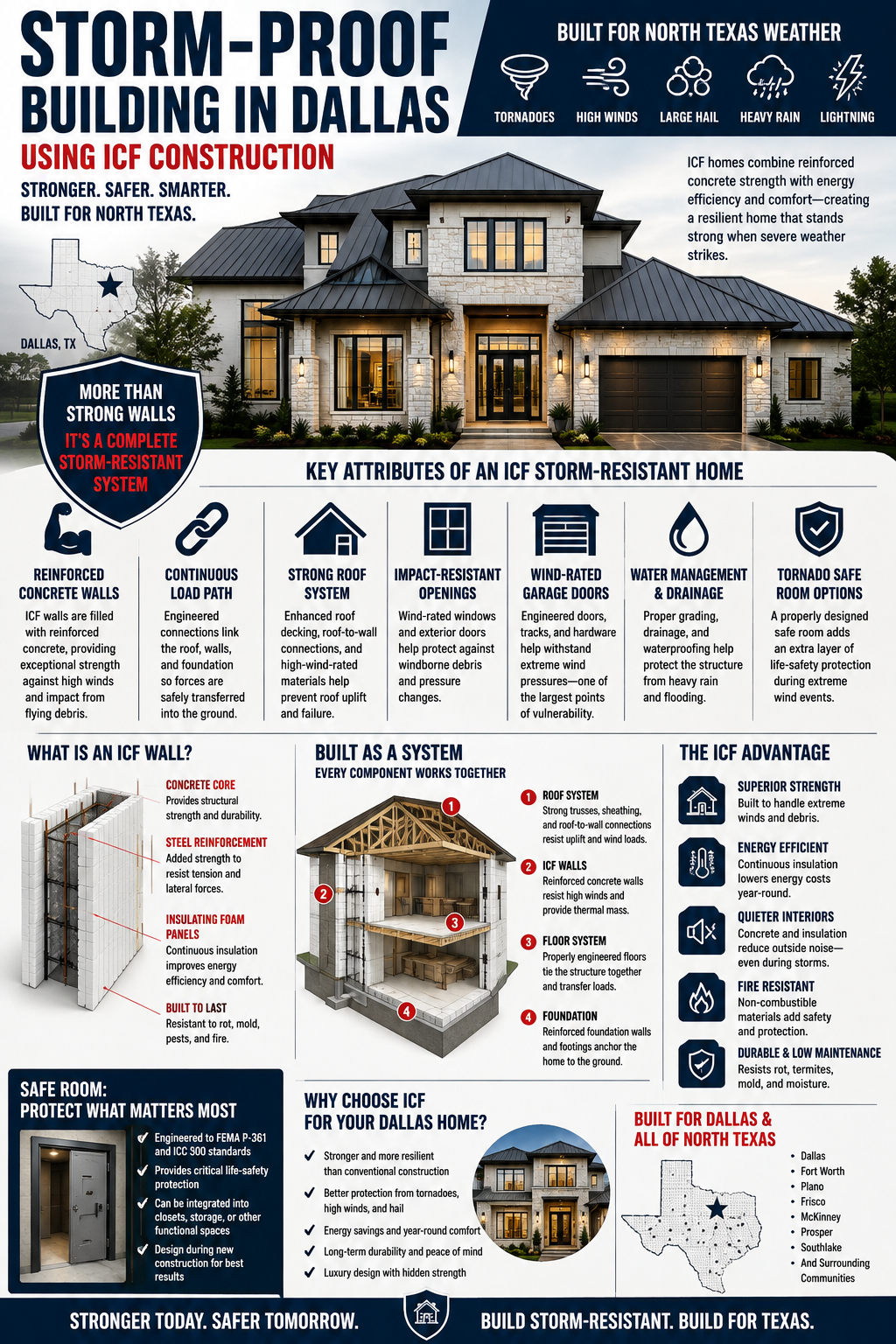
Building a home in Dallas means building in an environment where tornadoes, severe thunderstorms, destructive winds, large hail, flying debris, and intense rainfall are real concerns. The National Weather Service maintains an extensive tornado climatology for Dallas and surrounding North Texas counties, and recent storms continue to demonstrate the region’s exposure to damaging winds and hail. (National Weather Service) For homeowners who want to go beyond conventional construction, Insulated Concrete Form (ICF) construction can provide an exceptionally strong foundation for a storm-resistant Dallas home. ICF walls are constructed using insulating forms filled with reinforced concrete, creating a substantial structural wall system while also providing continuous insulation. FEMA has documented the use of reinforced ICF walls in hardened Texas construction specifically because of their ability to resist high wind pressures and windborne-debris impacts. (FEMA)
The real advantage of ICF construction isn’t simply that the walls contain concrete—it is the opportunity to make those walls part of a complete engineered storm-resistant structure. A Dallas ICF home should incorporate a continuous load path that securely connects the roof to the reinforced walls and the walls to the foundation so extreme wind forces can be transferred through the structure and into the ground. FEMA’s recommendations for improving residential tornado and windstorm performance specifically emphasize strengthening the building envelope, windows and doors, and load-path connections, along with proper installation of higher-performing components. (FEMA) The roof deserves particular attention because even extremely strong ICF walls cannot compensate for an inadequately designed roof system. Enhanced roof-deck attachment, engineered roof-to-wall connections, appropriate fasteners, high-wind-rated roofing, careful roof geometry, and protection against water intrusion can all contribute to a more resilient structure.
Windows, exterior doors, and garage doors must also be considered because they can become vulnerable points during extreme winds and flying-debris events. A well-designed Dallas ICF home can combine its reinforced concrete wall system with appropriately rated impact-resistant openings, stronger garage-door assemblies, reinforced connections, hail-resistant roofing materials, effective drainage, and careful waterproofing. FEMA notes that improved residential wind performance depends not just on stronger materials but on their correct installation and integration into the complete building envelope. (FEMA) This whole-home approach is critical: extremely strong walls provide limited benefit if another major component becomes the weak link.
For families seeking an even higher level of tornado life-safety protection, an ICF home can also be designed around a dedicated tornado safe room. A safe room is different from simply having reinforced exterior walls; it is specifically engineered for extreme wind and debris loads. FEMA guidance requires qualifying residential safe rooms to address extreme wind loads, missile impacts, anchoring, uplift, overturning, and sliding forces. (FEMA) Incorporating that space while the ICF home is being designed can allow it to function as a closet, storage area, or other useful room during everyday life while providing specialized protection when a tornado warning is issued.
ICF construction also offers benefits that matter during ordinary Dallas weather. The combination of reinforced concrete and continuous insulation can contribute to energy efficiency, temperature stability, sound reduction, durability, and a quieter interior during thunderstorms. FEMA’s Texas ICF case study specifically notes the system’s thermal-resistance and sound-reduction qualities in addition to its structural strength. (FEMA) This makes ICF particularly attractive for homeowners who want storm resilience without sacrificing comfort or luxury.
Most importantly, an ICF storm-resistant home doesn’t need to look like a concrete bunker. The reinforced concrete structure can sit behind stone, brick, stucco, contemporary finishes, or other architectural treatments. A Dallas ICF home can still feature luxury kitchens, dramatic entryways, outdoor living areas, pools, high ceilings, and sophisticated custom architecture. What changes is what lies beneath those finishes: reinforced concrete walls, engineered connections, stronger openings, a resilient roof system, and a structure intentionally designed around North Texas weather.
No responsible builder should guarantee that an ICF house is literally “storm proof” or capable of surviving every possible tornado. FEMA likewise distinguishes enhanced wind-resistant residential construction from the much higher occupant-protection level provided by a compliant tornado safe room or storm shelter. (FEMA) But for someone building a new custom home in Dallas, Fort Worth, Frisco, Plano, McKinney, Prosper, Celina, Southlake, or surrounding North Texas communities, ICF construction provides a powerful starting point for creating a stronger and more resilient home.
Build with concrete. Build with engineering. Build for the storms North Texas can deliver. Build stronger for Dallas.
Top 5 FAQs About Storm Risk in Dallas
1. What are the biggest storm risks facing Dallas homeowners?
Dallas–Fort Worth faces several major severe-weather threats, including tornadoes, damaging straight-line winds, large hail, flash flooding, lightning, and intense thunderstorms. The National Weather Service says large hail, damaging winds, flooding, and tornadoes occur nearly every year somewhere in the DFW Metroplex.
2. How serious is the tornado risk in Dallas?
Tornadoes are a well-documented North Texas hazard. The National Weather Service maintains Dallas County tornado records dating to 1880, and its broader North and Central Texas database recorded 1,953 tornadoes from 1950 through 2025, averaging about 26 per year across that larger region.
3. When is tornado and severe-storm risk highest in Dallas?
Severe weather can occur throughout the year, but spring is historically the peak severe-weather season in DFW. Across North and Central Texas, April and May have historically recorded the greatest numbers of tornadoes.
4. Is tornado damage the only reason to consider a storm-resistant Dallas home?
No. A house doesn’t have to take a direct tornado strike to suffer serious storm damage. Large hail, extreme wind, windborne debris, heavy rainfall, and flooding can damage roofs, windows, doors, garage doors, exterior finishes, and other parts of a home.
5. How can a new Dallas home be designed for severe weather?
A storm-resistant home should be approached as a complete structural system. Depending on the site and engineering, that can include stronger roof assemblies, a continuous load path connecting the roof, walls, and foundation, reinforced structural systems such as ICF, appropriately rated windows and doors, wind-resistant garage doors, improved drainage and water management, and a properly engineered tornado safe room. The goal isn’t to promise a “tornado-proof” house, but to build a stronger home specifically designed with North Texas weather in mind