
Storm resistant building for Houston
Storm Risk and ICF Building for Safety in Houston, TX
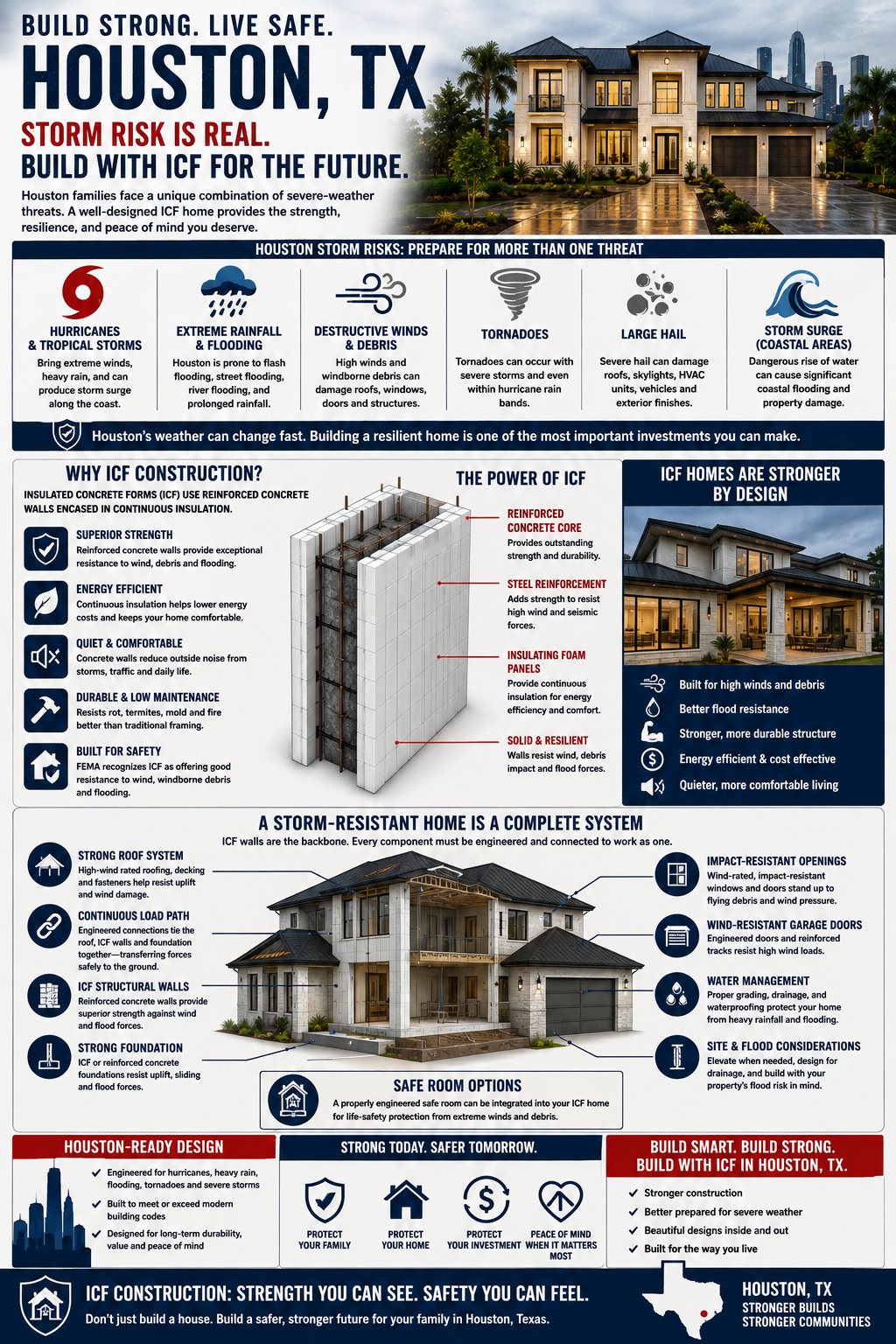
Building a home in Houston, Texas means preparing for an unusually broad range of severe-weather threats, including hurricanes, tropical storms, destructive winds, tornadoes, windborne debris, torrential rainfall, flash flooding, and—in areas closer to the Gulf—storm surge. The National Weather Service identifies extreme winds, inland flooding, storm surge, and tornadoes among the major hazards associated with tropical cyclones, and Houston-area history demonstrates that tornadoes and flooding can also occur during non-hurricane severe-weather events. (National Weather Service) For homeowners building from the ground up, this makes structural resilience especially important. Insulated Concrete Form (ICF) construction provides one approach to creating a stronger building envelope by using forms filled with reinforced concrete to create substantial structural walls surrounded by continuous insulation. FEMA guidance describes ICF as offering good resistance to wind, windborne debris, and flooding, while also providing durability, energy efficiency, and significant noise reduction. (FEMA) In Houston, however, strong walls are only the beginning. A resilient home should be engineered as a complete system, with the ICF walls properly connected to the foundation and roof to establish a continuous load path, while the roof assembly, windows, exterior doors, garage doors, waterproofing, drainage, grading, and other components are selected and designed for the hazards associated with the specific property. This whole-building approach is especially important during extreme winds because forces must be transferred from the roof through the walls and foundation and ultimately into the ground rather than allowing one weak connection to become the point where structural failure begins. FEMA has documented hardened ICF construction in which engineered connections were specifically designed to transfer extreme wind loads from the roof through the ICF walls and foundation into the ground. (FEMA)
For Houston homeowners, the advantage of ICF storm-resistant construction is therefore not simply having concrete walls—it is using those reinforced walls as the structural backbone of a home intentionally designed around the realities of Southeast Texas weather. Properly engineered ICF construction can be combined with a high-wind-resistant roof system, robust roof-to-wall connections, appropriately rated impact-resistant windows and doors, strengthened garage openings, carefully detailed flashing and waterproofing, and site-specific flood and drainage strategies. FEMA’s safe-room guidance also recognizes properly constructed reinforced-concrete ICF wall assemblies as capable of providing substantial windborne-debris resistance, although a normal ICF house should never be represented as equivalent to a compliant tornado or hurricane safe room; a dedicated safe room requires its own specialized engineering and construction criteria. (FEMA) That distinction is important: ICF does not make a Houston home indestructible or literally “storm proof,” and it cannot eliminate flood or storm-surge risk simply because the walls are concrete. Instead, ICF provides an exceptionally strong starting point for a comprehensive resilience strategy that addresses the structure from the foundation to the roof while also considering water, openings, debris, drainage, and occupant protection. For homeowners investing in a custom home in Houston and the surrounding Southeast Texas region, building with ICF provides an opportunity to combine strength with luxury architecture, energy efficiency, comfort, quiet interiors, and long-term durability—creating a home that doesn’t have to look like a fortress to have serious strength built behind its finishes. In Houston, the goal isn’t simply to build a beautiful home for sunny days; it’s to build a stronger home with the engineering and structural resilience to be better prepared when Texas weather is at its worst.
Top 5 FAQs About Storm Risk in Houston
1. What are the biggest storm risks facing Houston homeowners?
Houston and Southeast Texas face a combination of hurricanes, tropical storms, destructive winds, extreme rainfall, flash flooding, tornadoes, lightning, and severe thunderstorms. Coastal portions of the greater Houston region can also be affected by storm surge. The National Weather Service specifically identifies strong winds, flooding, storm surge, and tornadoes as major tropical-cyclone hazards.
2. How serious is hurricane risk in Houston?
Hurricane risk is a major consideration for Houston because tropical systems approaching the Upper Texas Coast can bring damaging winds and tremendous rainfall well inland. A storm does not have to make a direct hit on downtown Houston to cause significant damage across the metropolitan area.
3. Is flooding as important as wind when building a storm-resistant Houston home?
Absolutely. Houston’s storm-resistance strategy needs to address water as seriously as wind. Extreme rainfall can produce street, creek, river, and flash flooding, while wind-driven rain can penetrate vulnerable roofs, windows, doors, flashing, and other openings. The Houston/Galveston NWS office has repeatedly warned of potentially life-threatening flash flooding across Southeast Texas during extreme rainfall events.
4. Does Houston have a tornado risk too?
Yes. Tornadoes can occur with severe thunderstorms and can also develop within the rain bands of tropical storms and hurricanes. This means Houston-area homeowners shouldn’t think only about hurricanes when considering wind-resistant construction.
5. How can a new Houston home be designed to better withstand severe storms?
A storm-resistant Houston home should be designed as a complete system, potentially incorporating reinforced structural walls such as ICF, a continuous structural load path, stronger roof-to-wall and wall-to-foundation connections, appropriately rated windows and exterior doors, wind-resistant garage doors, enhanced roof assemblies, waterproofing, grading and drainage, and flood-conscious design based on the individual property. Backup power and a properly engineered safe room may also be considered. The goal isn’t simply to build for hurricane wind—it’s to build for wind, water, debris, flooding, and the realities of Southeast Texas weather.