
Storm resistant building for Austin

Storm Risk and Why Build an ICF Storm-Resistant Home in Austin, Texas

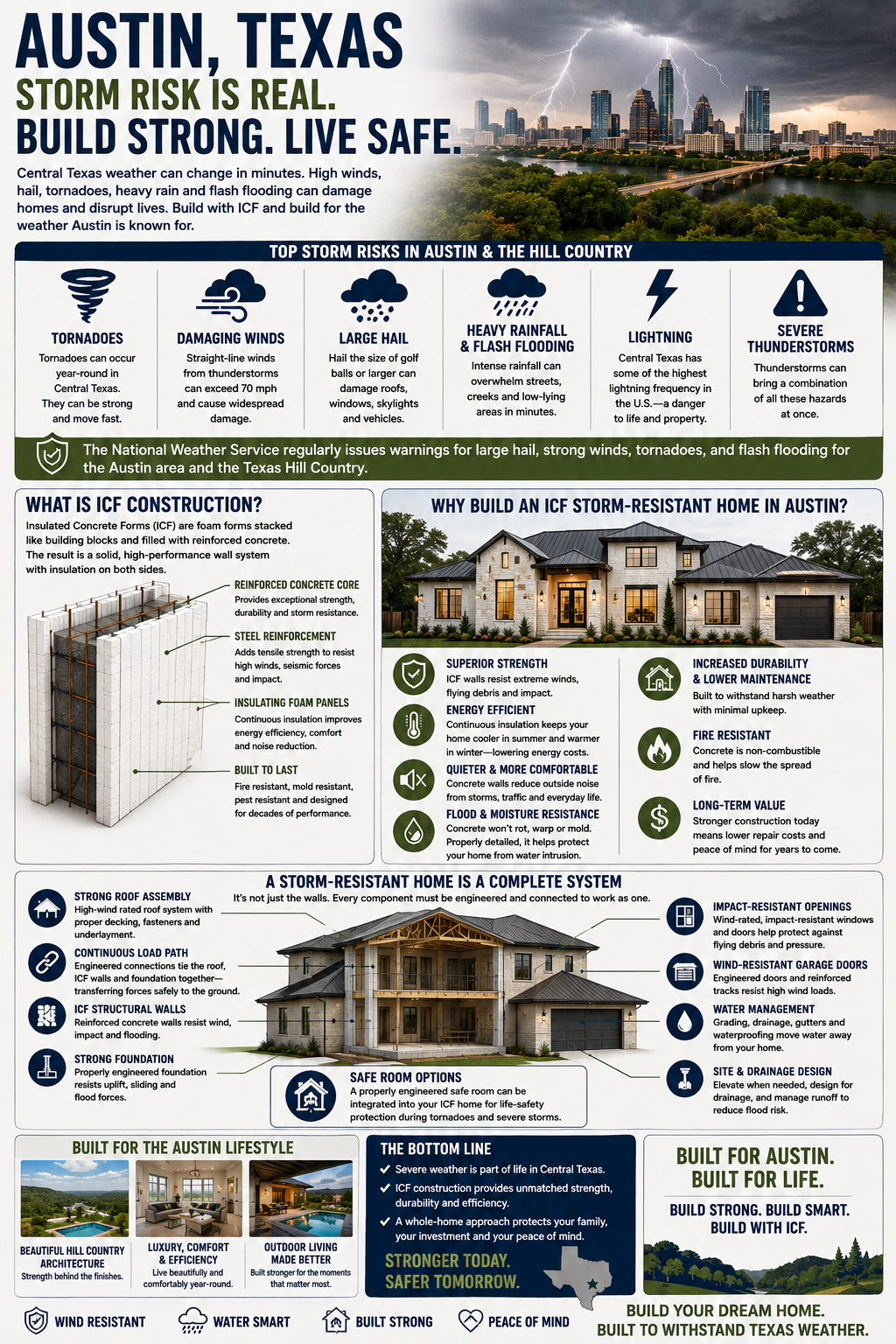
Building a home in Austin, Texas, and the surrounding Hill Country means designing for an environment where severe weather can arrive quickly and create several hazards at once. Central Texas can experience powerful thunderstorms, damaging straight-line winds, large hail, tornadoes, intense lightning, torrential rainfall, and dangerous flash flooding. National Weather Service Austin/San Antonio forecasts and warnings regularly identify large hail, strong winds, tornado potential, heavy rainfall, and flash flooding as threats across South-Central Texas and the Hill Country. These conditions can place tremendous stress on a home’s roof, walls, windows, exterior doors, garage openings, foundation, and structural connections, while Austin’s terrain can make water management equally important. For homeowners investing in new construction, Insulated Concrete Form (ICF) construction provides a powerful starting point for building a stronger, more resilient home. ICF construction uses insulating forms around a reinforced cast-in-place concrete wall, creating a substantial structural shell combined with continuous insulation. FEMA guidance notes that ICF provides good resistance to wind, windborne debris, and flooding, while also offering energy-efficiency, durability, low maintenance, and significant noise-reduction benefits—qualities particularly attractive for a home that must perform through both severe Texas storms and extreme summer conditions.

The real strength of an ICF storm-resistant Austin home, however, comes from designing the entire house as one connected system rather than relying on concrete walls alone. The reinforced ICF walls should be integrated with a properly engineered foundation, strong roof assembly, robust roof-to-wall connections, a continuous load path, appropriately rated windows and exterior doors, strengthened garage openings, impact-resistant roofing where appropriate, and carefully planned grading, drainage, flashing, and waterproofing. FEMA has documented hardened Texas ICF construction in which engineered connections transfer extreme wind loads from the roof through the ICF walls and foundation and ultimately into the ground—illustrating why the connections between components are just as important as the strength of the walls themselves. A properly engineered tornado safe room can also be incorporated for specialized life-safety protection; FEMA guidance recognizes certain reinforced concrete ICF wall configurations for safe-room debris resistance when they are designed and constructed to the required criteria. No home should be promised as literally “storm proof,” but ICF can form the structural backbone of an exceptionally resilient Austin home when combined with site-specific engineering and whole-home storm planning. And that strength doesn’t require sacrificing design: an ICF home can still feature beautiful Hill Country architecture, luxury finishes, expansive living spaces, pools, outdoor entertaining areas, and modern custom-home styling. The difference is what’s hidden beneath the finishes—reinforced concrete strength engineered for the realities of Central Texas. Build for the wind. Build for the hail. Build for the water. Build stronger for Austin.

Top 5 FAQs About Storms in Austin, Texas

1. What are the biggest storm risks in Austin, Texas?
Austin and Central Texas can experience severe thunderstorms, damaging straight-line winds, large hail, tornadoes, dangerous lightning, torrential rainfall, and flash flooding. The National Weather Service classifies thunderstorms as severe when they produce hail at least 1 inch in diameter or wind gusts of at least 58 mph. (National Weather Service)

2. Is flash flooding a serious concern in Austin?
Yes. Flash flooding is one of Austin’s most significant storm hazards. Intense rainfall can quickly overwhelm creeks, roads, drainage systems, and low-lying areas. In June 2026, the National Weather Service issued a Flash Flood Warning that included northern Travis County, with a “considerable” flash-flood damage threat. (National Weather Service)

3. Does Austin have a tornado risk?
Yes. Tornadoes are possible in Austin and throughout Central Texas, particularly when powerful severe-thunderstorm systems move through the region. NWS Austin/San Antonio severe-weather outlooks routinely consider tornadoes alongside large hail and damaging straight-line winds. (National Weather Service)

4. How serious are hail and damaging winds around Austin?
Both are important threats. Severe thunderstorms can produce winds strong enough to damage roofs, siding, trees, windows, and other building components, while large hail can damage roofing, skylights, windows, HVAC equipment, and vehicles. In May 2026, for example, an NWS warning in neighboring Williamson County called for 1.5-inch hail and 60-mph wind gusts. (National Weather Service)

5. How can an Austin home be better prepared for severe storms?
A storm-resistant Austin home should be designed around both wind and water. Depending on the site and engineering, that can include reinforced structural construction such as ICF, a continuous load path connecting the roof, walls, and foundation, stronger roof assemblies, appropriately rated windows and exterior doors, strengthened garage doors, impact-resistant roofing, and carefully engineered grading, drainage, and waterproofing. A properly engineered tornado safe room can provide an additional level of life-safety protection. The objective isn’t to promise a completely “storm-proof” house—it is to build a stronger, more resilient home specifically for the severe-weather realities of Austin and the Texas Hill Country.