
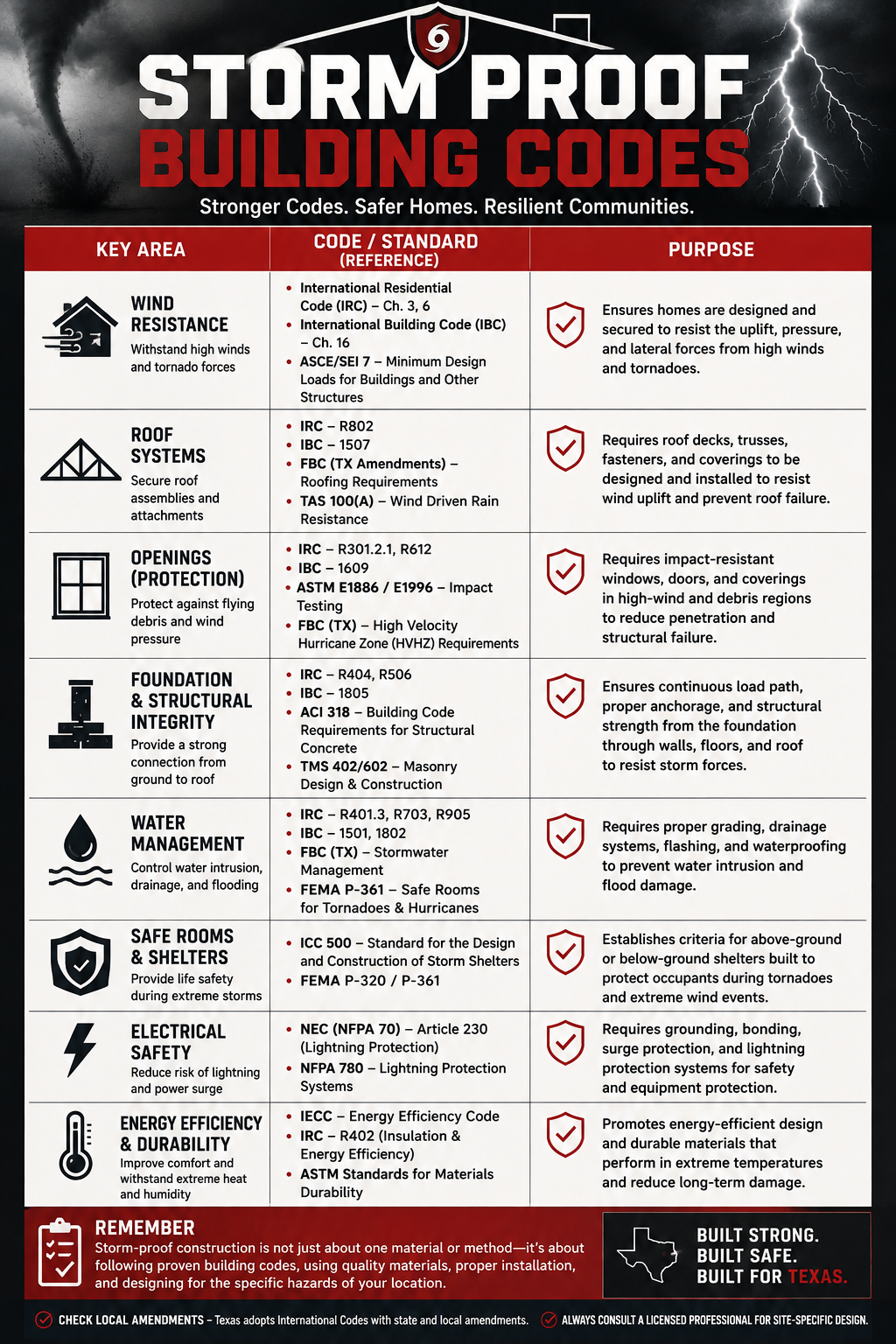
Top 10 Questions & Answers About Building an ICF Storm-Resistant Home
1. What is an ICF storm-resistant home?
An ICF storm-resistant home is constructed with Insulated Concrete Forms that create steel-reinforced concrete walls surrounded by continuous insulation. Unlike conventional wood framing, ICF construction provides a strong structural shell designed for exceptional durability, energy efficiency, and resistance to severe weather.
2. Can an ICF home withstand tornadoes and hurricanes?
ICF construction can be engineered for very high wind loads and significantly greater impact resistance than conventional wood framing. However, no home should be advertised as literally “storm proof.” Overall performance depends on the complete engineered system—including the walls, roof, connections, windows, doors, garage doors, and foundation.
3. Is an ICF home a good choice for Texas weather?
Yes. ICF is particularly well suited to Texas because it addresses both extreme heat and severe weather. Continuous insulation helps reduce heat transfer during hot Texas summers, while reinforced concrete walls provide increased strength during high winds, thunderstorms, hurricanes, and tornado conditions.
4. How much does an ICF storm-resistant home cost to build?
ICF construction can have a higher upfront cost than conventional wood framing, although the difference varies considerably by home design, location, labor, concrete prices, and engineering requirements. Homeowners should consider the total cost of ownership, including potential energy savings, durability, reduced maintenance, and long-term resilience.
5. Are ICF homes more energy efficient?
Yes. ICF walls combine continuous insulation, reduced air leakage, and concrete thermal mass to help maintain more stable indoor temperatures. In Texas, this can reduce the amount of work required from the home’s air-conditioning system and improve comfort during periods of extreme heat.
6. Can I add a safe room or storm shelter to an ICF home?
Absolutely. An ICF home can incorporate a dedicated reinforced safe room as part of the original design. For homeowners seeking a specifically rated storm shelter, the safe room should be separately engineered and constructed to the applicable FEMA guidance and ICC 500 requirements rather than assuming the home’s ICF walls alone make a room a certified storm shelter.
7. What type of roof and windows should an ICF storm-resistant home have?
The walls are only one part of a hardened home. A comprehensive design may incorporate engineered roof-to-wall connections, impact-resistant windows or protective systems, reinforced exterior doors, properly rated garage doors, and roofing designed for the project’s wind exposure. These components should work together as one engineered building envelope.
8. Can an ICF storm-resistant home still look luxurious?
Yes. ICF construction doesn’t mean your home has to look like a bunker. ICF can be used for contemporary estates, Texas ranch homes, Mediterranean residences, modern farmhouses, and other luxury designs. Open interiors, high ceilings, premium finishes, outdoor living spaces, and large window openings can all be incorporated when properly engineered.
9. How long will an ICF home last?
Reinforced concrete structures are known for exceptional longevity. ICF construction also eliminates structural wood from the ICF wall assembly, reducing concerns such as termites and rot within those walls. With quality construction, appropriate waterproofing, and regular maintenance of the rest of the building, an ICF home is designed for long-term performance.
10. How do I choose an ICF builder in Texas?
Look for a contractor with documented experience building ICF homes and working with structural engineers familiar with Texas wind loads, soil conditions, drainage, waterproofing, and local building requirements. Ask to see completed ICF projects, manufacturer training or certifications, references, and details about how the builder approaches the entire storm-resistant system—not simply the concrete walls.