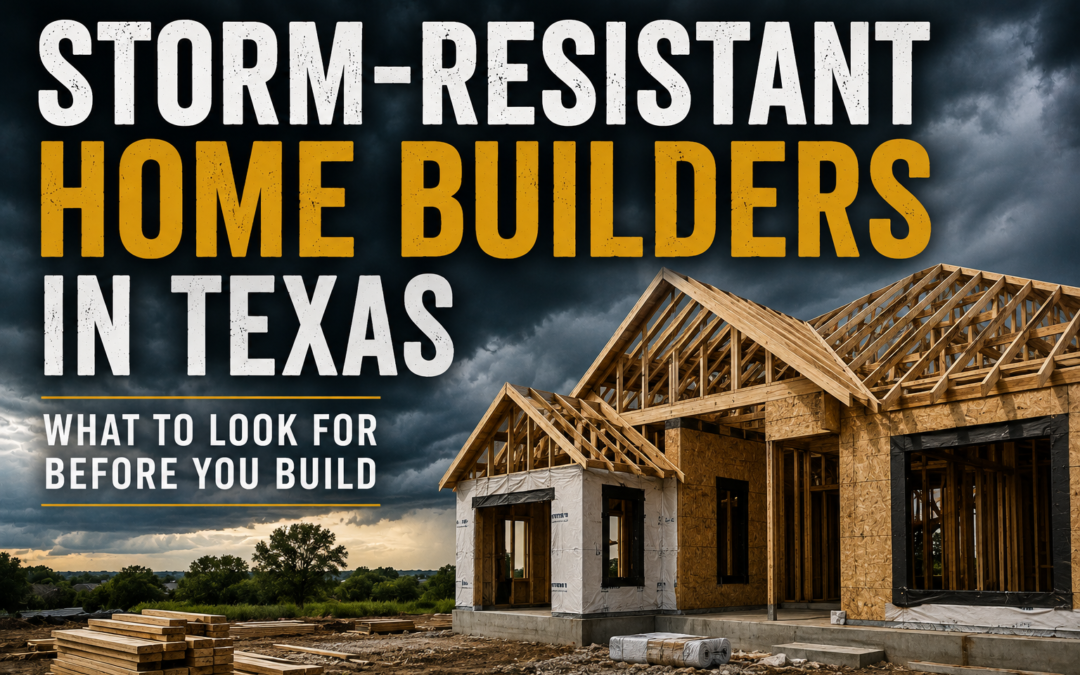
Storm-Resistant Home Builders in Texas: What to Look for Before You Build
Building a new home in Texas is a major investment—but choosing a builder based only on floor plans, finishes, price, and appearance can overlook one of the most important questions of all:
How will this home perform when Texas weather turns dangerous?
From tornadoes and destructive straight-line winds in North Texas to hurricanes and extreme rainfall along the Gulf Coast, Texas homes can be exposed to serious weather hazards. Large hail, flying debris, flooding, wind-driven rain, lightning, and extreme temperatures add additional challenges.
For homeowners interested in building a stronger home, finding the right storm-resistant home builder in Texas means looking beyond the surface. Storm resistance isn’t created by one product, one type of wall, or one upgraded roof. It begins with engineering, planning, construction quality, and making the major components of the home work together as a complete system.
Here are some of the most important things to consider before choosing a builder.
1. Does the Builder Understand Your Specific Texas Storm Risks?
There is no single storm-resistant home design that’s right for every part of Texas.
A home in Dallas–Fort Worth may need to place significant emphasis on tornadoes, severe thunderstorms, large hail, destructive winds, and flying debris.
A home near Houston or Galveston may have a different risk profile involving hurricanes, extreme winds, heavy rainfall, storm surge, flooding, and windborne debris.
Austin, San Antonio, Corpus Christi, Beaumont, and other areas have their own combinations of hazards.
That’s why one of the first questions to ask a potential builder is:
“What severe-weather hazards are you designing my home to resist?”
A serious answer should involve the property’s location, applicable building codes, engineering requirements, wind exposure, drainage and flood considerations, and the homeowner’s desired level of resilience.
2. Is Storm Resistance Part of the Design—or Just an Upgrade Package?
This is an important distinction.
Storm resistance shouldn’t simply mean selecting a few upgraded products after the architectural plans are finished.
The strongest approach begins during the design and engineering phase.
The foundation, wall system, roof structure, structural connections, windows, doors, garage openings, exterior materials, drainage, and potential storm shelter should all be considered as parts of the same system.
If resilience is important to you, tell your builder and design team before the plans are finalized.
It’s much easier to engineer strength into a house from the beginning than to attempt to add it later.
3. Ask About the Continuous Load Path
One phrase every homeowner considering storm-resistant construction should know is:
Continuous load path.
A continuous load path connects the major structural components of a house—from the roof through the walls and ultimately into the foundation—so wind forces can be transferred through the structure and into the ground.
The Insurance Institute for Business & Home Safety explains that when these connections aren’t sufficiently strong, wind can exploit weak points and structural failures can cascade. Continuous load-path construction is a fundamental part of the IBHS FORTIFIED approach to high-wind resilience. (ibhs.org)
Ask your builder:
How is the roof connected to the walls?
How are the walls connected to the foundation?
How are loads transferred through the complete structure?
A storm-resistant builder should be comfortable having this conversation with you and your project’s engineer.
4. Look Beyond the Roofing Material
Homeowners frequently ask:
“What’s the best roof for a storm-resistant home?”
That’s an important question, but roofing resilience involves much more than whether the finished surface is metal, tile, or shingles.
The roof deck, attachment methods, underlayment, flashing, roof edges, fasteners, geometry, structural framing, and connections between the roof and walls all influence performance.
IBHS identifies measures such as a sealed roof deck, stronger roof-deck attachment, and enhanced structural connections as important parts of high-wind resilience. (ibhs.org)
So don’t simply ask your builder:
“What kind of roof are you installing?”
Ask:
“How is the entire roofing system being designed for severe weather?”
That’s a much more important question.
5. Windows, Doors and Garage Doors Matter
A house is only as resilient as its vulnerable points.
Windows, exterior doors, garage doors, and other large openings deserve special attention because they can be subjected to tremendous wind pressure and flying debris.
The Texas Department of Insurance recommends asking builders about impact-resistant windows or shutters and notes recognized testing standards including ASTM E1886 and E1996. TDI also points out that garage doors can be particularly vulnerable to high winds because they span such large openings. (Texas Department of Insurance)
When discussing a storm-resistant home, ask what wind-pressure ratings and impact requirements apply to your location and how the selected windows, doors, garage doors, and installation systems address them.
Don’t assume that an expensive window automatically means a storm-resistant window.
6. Ask How the Home Will Handle Water
Wind gets a lot of attention during major storms, but water can be just as destructive.
Heavy Texas thunderstorms and tropical systems can produce enormous amounts of rainfall.
A storm-resistant home should therefore include thoughtful water-management strategies involving grading, drainage, roofing, flashing, exterior penetrations, doors, windows, waterproofing, and foundation design.
The goal isn’t simply keeping the house standing.
It’s also keeping water outside of it.
Ask the builder how water will move around the property during extreme rainfall and what systems are being incorporated to reduce the likelihood of water intrusion.
7. Consider a Tornado Safe Room During the Design Phase
For homeowners in tornado-prone parts of Texas, a safe room deserves serious consideration.
A storm-resistant house and a tornado safe room serve related but different purposes.
The home is engineered to improve overall structural resilience.
The safe room is specifically designed to provide a higher level of life-safety protection for occupants during extreme wind events.
FEMA’s current P-361 guidance addresses safe rooms designed to provide near-absolute protection from extreme winds and windborne debris when constructed according to FEMA criteria. The current guidance is based in part on the 2023 edition of the ICC/NSSA Standard for the Design and Construction of Storm Shelters, commonly known as ICC 500. (FEMA)
If you’re building a custom home, consider discussing the safe room early enough that it can be integrated into the architecture instead of appearing as an afterthought.
A safe room could potentially be incorporated into a closet, storage area, garage-adjacent space, or another location depending on the home’s design and engineering requirements.
8. Ask Which Building Codes and Standards Apply
“Built to code” sounds reassuring, but homeowners should understand which code, which edition, and which local requirements apply to their project.
Texas requirements can vary by jurisdiction and location.
Coastal construction has additional considerations. As of April 1, 2026, applications under the Texas Department of Insurance Windstorm Inspection Program must be certified under either the 2024 International Residential Code or 2024 International Building Code. TDI also notes that required wind speeds are determined based on the location of each structure and that much of its designated catastrophe area falls within the windborne-debris region. (Texas Department of Insurance)
For applicable coastal properties, TDI states that meeting certain construction standards is necessary to obtain windstorm insurance through the Texas Windstorm Insurance Association. (Texas Department of Insurance)
Ask your builder and engineer exactly which codes, local amendments, wind-speed requirements, flood requirements, and other standards apply to your property.
9. Don’t Confuse “Code Compliant” With “Indestructible”
This is one of the most important things homeowners should understand.
Building codes establish important minimum requirements, but meeting code doesn’t mean a home is guaranteed to survive every conceivable tornado, hurricane, flood, or other disaster.
Likewise, terms such as “tornado proof,” “hurricane proof,” and “storm proof” should be approached carefully.
No responsible builder should promise that an ordinary home is indestructible.
A better goal is a storm-resistant or resilient home designed and engineered to perform substantially better against the hazards expected at its location.
The conversation should be about reducing vulnerabilities, strengthening critical systems, protecting occupants, and improving the home’s ability to withstand severe conditions.
10. Ask Who Is Engineering the Home
When you’re making significant changes to a home’s structural system, engineering matters.
Ask whether a qualified structural engineer will be involved and how the architect, engineer, builder, and specialty contractors will coordinate.
A storm-resistant house should not be a collection of independently selected “storm-rated” products.
The entire system needs to work together.
A strong roof attached to weak walls isn’t enough.
Strong walls without proper foundation anchorage aren’t enough.
Impact-resistant windows don’t compensate for inadequate structural connections.
And a safe room doesn’t make the rest of the home storm resistant.
Engineering brings these systems together.
11. Ask How Construction Quality Will Be Verified
Excellent plans can still produce a poor-performing home if they’re not followed correctly.
Fastener spacing matters.
Connector installation matters.
Roof attachment matters.
Window installation matters.
Flashing matters.
Foundation anchoring matters.
Waterproofing matters.
This is why inspections and construction oversight are so important.
For homes in applicable Texas coastal windstorm areas, inspections are part of the certification process used to determine compliance with TDI windstorm requirements. (Texas Department of Insurance)
Even outside those areas, homeowners interested in resilient construction should ask what quality-control procedures, inspections, engineering observations, photographs, documentation, and product certifications will be used during construction.
What gets specified should also get verified.
12. Ask About Resilience Beyond the Storm
A well-designed resilient home can offer benefits beyond severe-weather performance.
Depending on the materials and systems selected, homeowners may also achieve improvements in:
-
Energy efficiency
-
Indoor comfort
-
Air sealing
-
Moisture management
-
Sound reduction
-
Durability
-
Fire resistance
-
Maintenance requirements
-
Long-term building performance
Texas homes need to withstand more than occasional storms. They also face months of intense heat, humidity in many regions, temperature swings, and heavy rainfall.
A resilient home should be designed for everyday Texas conditions as well as extraordinary ones.
The Questions You Should Ask Before Hiring a Storm-Resistant Home Builder
Before signing a construction contract, ask potential builders questions that go beyond countertops and flooring:
What severe-weather hazards are you designing my home for?
What design wind speed applies to my location?
How will you create a continuous load path from the roof to the foundation?
What roofing system and attachment methods will be used?
What wind and impact ratings apply to my windows and doors?
How is the garage door being protected?
How will the property manage extreme rainfall?
Should we incorporate a FEMA-guidance/ICC 500 safe room?
Which building codes and local amendments apply?
Who is responsible for structural engineering?
How will critical storm-resistant components be inspected and documented during construction?
The quality of the answers can tell you a great deal about whether storm resilience is truly part of the builder’s approach—or simply a marketing phrase.
A Storm-Resistant Home Starts Before Construction
The biggest advantage a homeowner building from the ground up has is the opportunity to make these decisions before the first foundation is poured.
That’s when structural systems can be engineered properly.
That’s when a safe room can be integrated into the floor plan.
That’s when stronger roof and wall connections can be specified.
That’s when windows, doors, drainage, roofing, and foundation systems can be evaluated together.
And that’s when the additional cost of resilience can be considered alongside the overall construction budget instead of becoming an expensive retrofit later.
Build a Beautiful Home—But Build a Strong One
A storm-resistant home doesn’t need to look like a bunker.
Modern architecture, luxury finishes, expansive living spaces, beautiful kitchens, outdoor entertaining areas, large windows, and custom design can still be part of the project.
The difference is what’s happening behind the finishes.
It’s the engineering.
It’s the connections.
It’s the foundation.
It’s the roof attachment.
It’s the protected openings.
It’s the drainage.
It’s the attention to details homeowners may never see once construction is complete.
Those details can become extremely important on the day severe Texas weather arrives.
Choosing a Storm-Resistant Home Builder in Texas
When comparing Texas builders, don’t simply ask:
“Can you build my dream home?”
Ask:
“Can you build my dream home with severe Texas weather in mind?”
The answer should involve engineering, applicable codes and standards, site-specific hazards, quality construction, appropriate materials, and an integrated approach to resilience.
Because when the sky turns dark and severe-weather alerts begin appearing, the granite countertops and beautiful finishes won’t be what matters most.
The structure surrounding your family will.
Planning a Storm-Resistant Home in Texas?
If you’re considering building a new home in Dallas–Fort Worth, Houston, Austin, San Antonio, the Texas Gulf Coast, or elsewhere in Texas, start the storm-resistance conversation before your plans are finalized.
Contact Texas Storm Resistant Homes to discuss your property, your goals, and the construction strategies that can be considered when designing a stronger, more resilient Texas home.
Build the home you want. Build the strength you may someday need. Build for Texas.
For SEO, I’d internally link this article to your Dallas Tornado Risk article and “What Makes a Home Storm Resistant? 10 Features Texas Homeowners Should Know.” Those three pages create the beginning of a strong topic cluster around storm-resistant homes Texas and storm-resistant home builders Texas. (Texas Department of Insurance)