
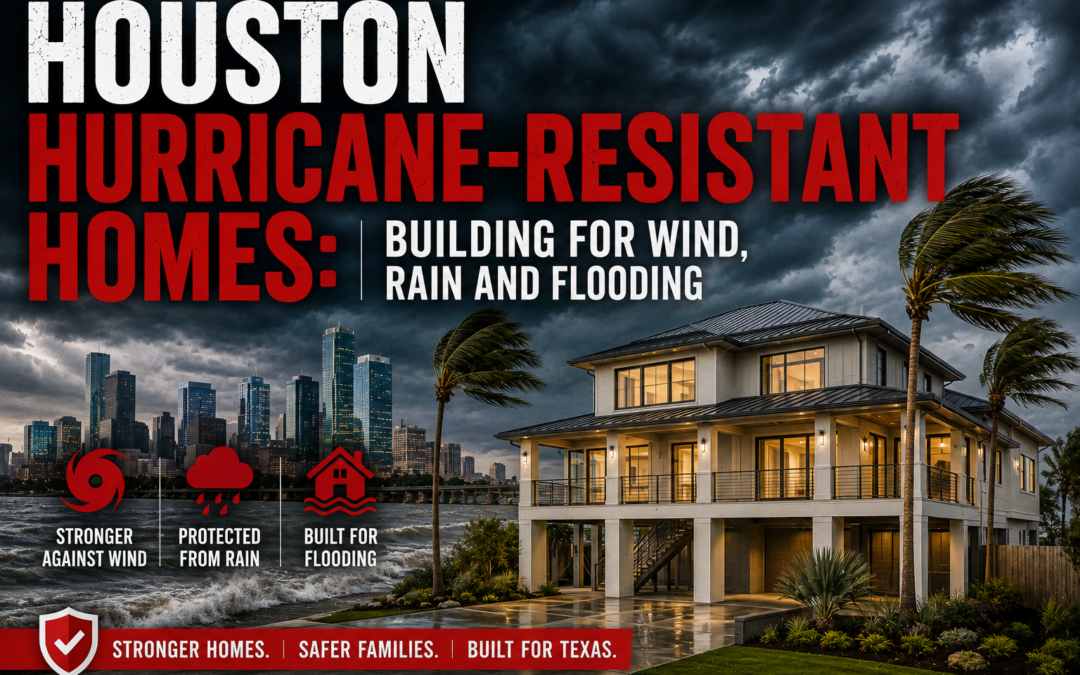
Houston Hurricane-Resistant Homes: Building for Wind, Rain and Flooding
Building a home in the Houston area means designing for one of the most challenging severe-weather environments in Texas. Houston homeowners can face hurricanes, tropical storms, extreme winds, wind-driven rain, flash flooding, prolonged heavy rainfall, flying debris, lightning, and extended power outages. While no conventional home can responsibly be described as completely “hurricane-proof,” today’s engineering, building materials, construction methods, and storm-resilience strategies can provide homeowners with opportunities to build substantially stronger homes.
For anyone planning new construction in Houston, the question shouldn’t simply be, “Will my home meet code?” It should also be: “How can we design this home to perform better when the next major Gulf Coast storm arrives?”
Houston’s Hurricane Risk Is Real
Houston’s proximity to the Gulf of Mexico means hurricanes and tropical storms are a recurring regional threat. The National Weather Service notes that the Texas coast is vulnerable to hurricane hazards including storm surge, inland flooding, high winds, tornadoes, and rip currents.
Some of the most destructive Houston-area disasters have also demonstrated that wind isn’t the only concern. Hurricane Harvey made landfall on the Texas coast in August 2017 and produced catastrophic rainfall and flooding across southeast Texas. NOAA reported that Harvey dropped more than 60 inches of rain in parts of the region—setting a U.S. tropical-cyclone rainfall record at the time.
For homeowners, the lesson is important:
A hurricane-resistant Houston home needs to address both wind and water.
1. Start With the Specific Risk at Your Property
Not every Houston-area property faces exactly the same hazards.
A house in central Houston may have a different flood and wind exposure than a home closer to Galveston Bay. Properties in Katy, Cypress, Sugar Land, The Woodlands, Pearland, Friendswood, League City, Clear Lake, or other surrounding communities can also have different site conditions.
Before designing the home, the project team should evaluate factors such as applicable design wind speeds, flood-zone information, drainage, elevation, soil conditions, exposure, local building requirements, and the property’s relationship to coastal hazards.
Storm resilience should be site-specific, not a generic package added to every home.
2. Create a Continuous Load Path
One of the fundamental principles of wind-resistant construction is the continuous load path.
During hurricane-force winds, tremendous forces can push against a house while simultaneously creating uplift on the roof. Those forces need to travel safely through the structure.
A continuous load path uses engineered connections to tie the roof to the walls, the walls to the floors, and the structure to the foundation.
The Insurance Institute for Business & Home Safety identifies a continuous load path as an important part of strengthening buildings against high winds because structural failure can begin at weak connections.
This means hurricane resilience isn’t just about building stronger individual components.
It’s about connecting those components together.
3. Build a Roof Designed to Stay Attached
During a hurricane, your roof is one of the home’s most exposed structural systems.
Extreme winds can create substantial uplift forces, particularly around roof edges, corners, overhangs, and other vulnerable areas.
A hurricane-resistant roofing strategy should consider the entire assembly:
-
Roof geometry and framing
-
Roof-deck attachment
-
Fasteners and fastening patterns
-
Roof-to-wall connections
-
Underlayment
-
Sealed roof-deck strategies
-
Flashing
-
Roof edges
-
Roof covering
-
Penetrations and vents
A beautiful premium roof isn’t automatically a hurricane-resistant roof.
How the roof is engineered, attached, sealed, and connected to the structure can be just as important as what homeowners see from the street.
4. Protect Windows and Doors From Wind and Debris
Flying debris is a serious concern during high-wind events.
Branches, roofing materials, signs, fencing, and other objects can become projectiles.
If windows or exterior doors fail, wind and rain can enter the building. That can expose the interior to water and potentially increase internal pressure.
Texas Department of Insurance windstorm guidance addresses impact protection for glazed openings in applicable windborne-debris regions and references recognized testing standards for these systems.
Depending on the property’s location and applicable requirements, a project may consider appropriately rated impact-resistant windows and doors or approved protective systems.
The key is making every major opening part of the home’s overall storm-resistance strategy.
5. Don’t Let the Garage Become the Weak Point
Houston custom homes can have enormous garage openings.
Three-car garages, four-car garages, oversized doors, and RV garages may create some of the largest openings in the building envelope.
During high winds, the garage door, tracks, hardware, anchorage, and surrounding structure can experience tremendous pressure.
That’s why garage-door wind ratings should be considered during the original design rather than treated as an afterthought.
A house with an exceptionally strong structural shell can still have a major vulnerability if one of its largest openings hasn’t been appropriately designed for the conditions it may encounter.
6. Houston Homes Must Be Designed for Water
This is where hurricane-resistant construction in Houston becomes especially important.
Wind is only half of the equation.
A home can remain structurally standing and still suffer catastrophic damage from water.
Heavy rainfall can overwhelm drainage systems. Wind-driven rain can enter through roof assemblies, vents, windows, doors, flashing, and exterior penetrations. Surface water can accumulate around foundations.
And flooding can introduce an entirely different level of risk.
That’s why resilient Houston home design should carefully consider site elevation, grading, drainage, roof drainage, waterproofing, flashing, exterior penetrations, foundation design, and flood exposure.
FEMA recommends determining a property’s flood risk and incorporating appropriate flood-resistant design and construction measures where needed.
For some properties, that may affect the elevation of the structure itself.
7. Build Above the Water When Appropriate
For homes with meaningful flood exposure, one of the most powerful strategies can be increasing the elevation of vulnerable occupied portions of the structure.
Flood-resistant construction may involve elevating the building above required minimum elevations, designing foundations to accommodate flood conditions, locating critical mechanical or electrical equipment higher, and using flood-resistant materials in appropriate areas.
The exact strategy depends heavily on the property.
There is no responsible universal answer such as “every Houston house should be elevated by X feet.”
Flood maps, required elevations, local regulations, engineering, drainage, and site conditions all need to be evaluated.
But for someone building a new home rather than retrofitting an existing one, these decisions can be made before the foundation is constructed.
That is an enormous advantage.
8. Consider What Happens When the Power Goes Out
Resilience doesn’t end when the storm passes.
Major hurricanes can cause prolonged power outages, disrupted communications, blocked roads, and interruptions to water or other services.
For homeowners who want greater resilience, new construction provides an opportunity to consider whole-home generators, properly located mechanical equipment, surge protection, battery backup, protected electrical systems, and other emergency-power strategies.
The objective isn’t simply surviving the hours when the hurricane is overhead.
It’s creating a home that can better support the people living inside it during the days that follow.
9. Consider a Properly Designed Safe Room
A hurricane-resistant house and a safe room serve different purposes.
The overall structure is intended to improve the home’s ability to withstand severe weather.
A properly designed safe room is specifically intended to provide a high level of life-safety protection during extreme wind events.
FEMA’s safe-room guidance addresses tornado and hurricane safe rooms designed to provide near-absolute protection when constructed according to FEMA criteria. FEMA P-361 incorporates criteria associated with ICC 500, the standard for storm shelters.
For a custom Houston home, discussing this during architectural planning can allow the safe room to be integrated into the floor plan instead of becoming an obvious retrofit later.
10. Coastal Texas Has Additional Windstorm Requirements
Homeowners building closer to the Texas coast need to understand that special requirements may apply.
The Texas Department of Insurance’s Windstorm Inspection Program establishes construction and inspection requirements for structures seeking certification in designated catastrophe areas. For applicable projects beginning April 1, 2026, TDI adopted the 2024 International Residential Code and 2024 International Building Code for its windstorm program.
Certification can also be important for eligibility for wind and hail insurance through the Texas Windstorm Insurance Association in applicable areas.
This is another reason to investigate requirements before construction starts rather than discovering them after critical portions of the building are complete.
Hurricane Resistance Is About the Entire Building
One of the biggest mistakes homeowners can make is searching for a single “hurricane-proof” product.
There isn’t one.
Impact-resistant windows alone don’t make a house hurricane resistant.
A metal roof alone doesn’t make a house hurricane resistant.
Concrete walls alone don’t make a house hurricane resistant.
A generator doesn’t make a house hurricane resistant.
And simply elevating a home doesn’t address wind vulnerability.
True resilience comes from creating a coordinated building system.
The foundation supports the walls.
The walls support and restrain the roof.
Structural connectors transfer loads.
Windows and doors protect openings.
Roofing and flashing manage water.
Grading and drainage move rainfall away.
Flood-conscious design addresses rising water.
Backup systems help the home remain functional afterward.
Every layer matters.
A Hurricane-Resistant Home Can Still Be a Luxury Home
Strength doesn’t mean sacrificing design.
A resilient Houston home can still have stunning architecture, beautiful stone and stucco exteriors, high ceilings, expansive kitchens, luxury primary suites, swimming pools, outdoor living areas, smart-home technology, premium finishes, and sophisticated landscaping.
Much of the resilience can be engineered behind what you see.
The structural connector hidden inside a wall.
The additional roof-deck fastening underneath the roofing.
The properly detailed flashing behind the exterior finish.
The stronger garage-door assembly.
The elevated mechanical equipment.
The engineered foundation.
These features may never receive compliments at a dinner party.
But during a major Gulf Coast hurricane, they may become some of the most important parts of the entire home.
Build Beyond Minimum Expectations
Building codes are essential, but homeowners planning a custom home can also ask whether additional resilience measures make sense for their project.
Ask your builder, architect, and engineer:
What wind speed is this home being designed for?
How does the roof connect to the walls?
How do the walls connect to the foundation?
How are windows, doors, and garage openings protected?
What happens during extreme rainfall?
What is this property’s flood exposure?
Should we build above minimum flood-elevation requirements?
Where are the HVAC, electrical, and backup-power systems located?
Would a safe room make sense?
Those questions move the conversation from simply constructing a home to planning a resilient one.
Houston Will Experience Another Major Storm
No one knows precisely when the next major hurricane will affect the Houston area.
But Houston’s history and Gulf Coast location make one thing clear:
There will be more storms.
The best time to think about hurricane resistance isn’t when the Gulf forecast shows a developing tropical system.
It isn’t when plywood disappears from local stores.
And it isn’t when evacuation routes begin filling with traffic.
For someone building a new home, the best time is before the architectural and engineering plans are finished.
That’s when the greatest number of options remain available.
Build for Houston. Build for the Gulf Coast.
You can’t control the Gulf of Mexico.
You can’t stop a hurricane from strengthening.
You can’t control how much rain falls.
But you can make informed decisions about the home you’re building.
For homeowners planning new construction in Houston, The Woodlands, Katy, Cypress, Sugar Land, Pearland, Friendswood, Clear Lake, League City, Galveston, or surrounding Southeast Texas communities, storm resilience should be part of the conversation from day one.
Planning a Hurricane-Resistant Home in Houston?
If you’re considering building a custom home in the Houston area, begin discussing hurricane and storm resistance before your plans are finalized.
Contact Texas Storm Resistant Homes to discuss your property, your goals, and construction strategies that can help create a stronger and more resilient home for the realities of Gulf Coast weather.
Build for the wind. Build for the rain. Build for the water. Build for Texas.